
 Factory Automation
 Logistics Automation
 Process Automation
 Crane Collision Avoidance
 LiDAR Sensors
 Safety Laser Scanners
 Optical Data Transmission
 Hot Metal Detectors
 Laser Distance Sensor
 Blog
 Whitepapers
 Case Studies
 Infographics




LiDAR for AMRs & AGVs: An Engineer's Selection Guide
Autonomous mobile robots and automated guided vehicles depend on 2D LiDAR to localize, map, and avoid obstacles, and on safety laser scanners to protect the people working around them. This guide covers what to evaluate, how Hokuyo's sensor families differ, and which model fits your robot.
Navigation LiDAR vs. Safety Laser Scanners
The first decision on any AMR or AGV sensor package is which job each sensor is doing. Navigation and personnel protection are different functions with different requirements, and most production robots need both.
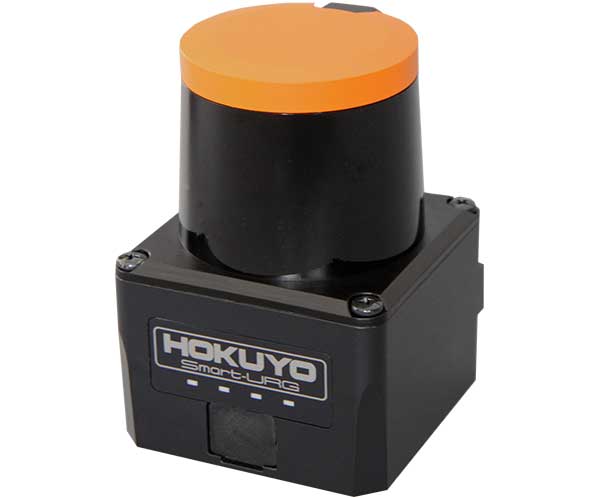
2D LiDAR sensors (UST series)
- Streams distance and intensity data over Ethernet for SLAM, localization, and mapping
- Detects obstacles so the robot can re-plan its path
- Compact and low-power, suited to battery-operated platforms
- Not a safety-rated device: it can't be the sensor that stops the robot to protect a person
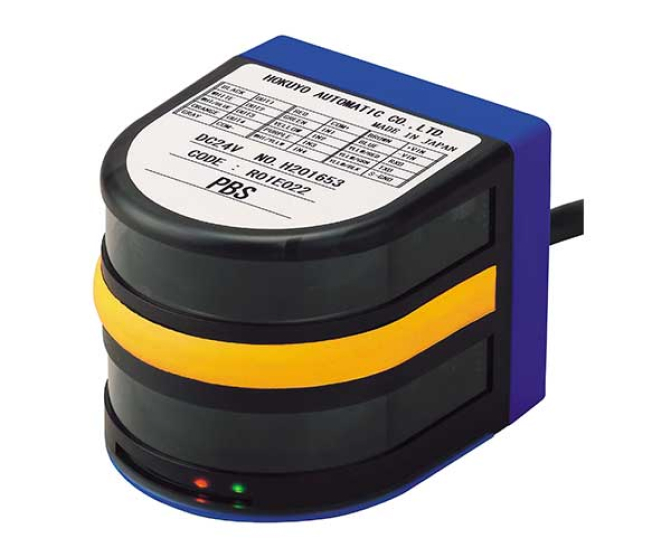
Safety laser scanners (UAM series)
- Certified to ISO 13849-1 (PL d, Cat. 3) and IEC 61496-1/3 (Type 3)
- Configurable protective fields that stop the vehicle and warning fields that slow it
- Switchable area patterns for different speeds, directions, and turns
- Also outputs distance data that can support navigation, evaluated separately from the safety function
2D vs. 3D LiDAR for Mobile Robots
A 2D LiDAR scans a single horizontal plane, typically mounted at a height that captures walls, racking, and people. For indoor AMRs in warehouses and factories, that plane carries most of the information navigation needs, which is why compact 2D LiDAR is the default starting point.
Consider 3D or multi-layer sensing when the hazards your robot faces sit above or below a single scan plane:
- Overhangs: table tops, conveyor frames, and protruding pallet loads
- Low obstacles: fork tines, dropped product, and floor-level debris
- Changing terrain: ramps, dock plates, and uneven outdoor surfaces
- Tall or articulated vehicles: tuggers and AMRs carrying lifts or arms
Hokuyo's UCT-10LCM multi-layer LiDAR and YVT/YHT 3D LiDAR families add that vertical awareness. Many fleets use 2D LiDAR for localization and add multi-layer sensing only where the risk profile calls for it. Read more in 2D LiDAR vs. 3D LiDAR: Which Is Better for Your AMR Fleet?
The Specs That Matter for AMR Navigation
Detection range
Size range to the farthest feature your robot needs to localize against, not just the nearest obstacle. Narrow aisles with close racking work well at 5–10 m. Open floors, cross-docks, and large facilities where walls are far away benefit from 20–30 m so the robot always sees enough landmarks to hold its position.
Field of view
The UST and UAM families scan a 270° field of view, covering the front and both sides of the robot from a single sensor. That leaves a 90° blind sector behind the mounting point, so plan corner mounting or a second sensor if the robot reverses or turns in place near people.
Scan rate
The UST-05LX, UST-10LX, and UST-20LX complete a scan every 25 ms (40 scans per second). Faster scans mean fresher data at higher travel speeds and more stable localization during turns.
Angular resolution
Angular resolution sets the spacing between measurement points, and that spacing grows with distance. At 0.25°, points land roughly 4.4 cm apart at 10 m and about 8.7 cm apart at 20 m. The UST-15LX and UST-30LX can switch to 0.125°, halving that spacing, which helps when the robot must resolve thin features such as rack uprights or pallet edges at long range.
Power and interface
UST-series sensors are designed for low power consumption on battery-operated platforms and deliver distance and intensity data over Ethernet, which keeps wiring simple on the vehicle.
ROS and SLAM Integration
UST-series 2D LiDAR sensors are ROS1 and ROS2 compatible. Their Ethernet output publishes as a standard laser-scan stream, so common SLAM and localization stacks can consume it without custom drivers. Intensity data adds a second channel some teams use for reflector-based localization or for distinguishing surfaces.
For integration support, spec sheets, and connection details, see each product page or the product spec sheet library.
Indoor vs. Outdoor Operation
Indoor warehouse and factory AMRs typically run well on the compact UST-05LX, UST-10LX, or UST-20LX. Robots that work outdoors or move between indoor and outdoor areas face rain, dust, fog, and direct sunlight, which call for different hardware:
- UST-15LX and UST-30LX: IP67 protection with multi-echo processing, which helps separate real targets from rain, dust, and other airborne particles
- URM-40LC-EWT and UXM series: outdoor-rated 2D LiDAR for industrial vehicles and demanding environments
AMR & AGV Sensor Picker
Use this table as a starting point, then confirm details on each product's spec sheet.
| Model | Role | Range | FOV | Resolution / scan | Environment | Best fit |
|---|---|---|---|---|---|---|
| 2D navigation LiDAR | ||||||
| UST-05LX | Navigation, obstacle detection | 5 m | 270° | 0.25° / 25 ms | Indoor | Small AMRs and carts in tight spaces |
| UST-10LX | Navigation, localization, mapping | 10 m | 270° | 0.25° / 25 ms | Indoor | The go-to starting point for warehouse and factory AMRs |
| UST-20LX | Navigation, localization, mapping | 20 m | 270° | 0.25° / 25 ms | Indoor | Large facilities and open floors with distant landmarks |
| UST-15LX | Navigation, mapping | 15 m | 270° | 0.25° or 0.125° | Outdoor, IP67, multi-echo | Robots working outdoors or moving between indoor and outdoor areas |
| UST-30LX | Navigation, mapping | 30 m | 270° | 0.25° or 0.125° | Outdoor, IP67, multi-echo | Long-range outdoor navigation, yards, and large sites |
| Safety laser scanners | ||||||
| UAM-05LP | Personnel protection + measurement data | 5 m protective / 20 m warning | 270° | 32 area patterns | Indoor | Compact AGV, AMR, and cart safeguarding |
| UAM-05LPA | Personnel protection + measurement data | 5 m protective / 30 m warning | 270° | 128 area patterns, encoder input | Indoor, improved environmental resistance | Speed-dependent fields on faster or more complex vehicles |
| UAM-05LECA-T301 | Personnel protection over EtherCAT | See spec sheet | Up to 176 area patterns | Indoor | Vehicles and systems built on an EtherCAT safety network | |
| Obstacle detection & multi-layer | ||||||
| UST-05LN / 10LN / 20LN | Obstacle detection with switched outputs | 5 / 10 / 20 m | See spec sheet | Indoor | Detection zones for AGVs that don't need full scan data | |
| UCT-10LCM | Multi-layer obstacle detection | See spec sheet | Industrial | Detecting overhangs and low obstacles a single plane can miss | ||
Five questions to answer before you shortlist
- What is each sensor's job? Navigation, personnel protection, obstacle detection, or a combination.
- How far are your landmarks? This sets the range class more than the nearest obstacle does.
- How fast does the robot travel and stop? Speed and stopping distance drive both scan-rate needs and safety field size.
- Where will it operate? Indoor only, outdoor, or both, and what dust, moisture, or sunlight it will see.
- What is the controller stack? ROS1/ROS2, a proprietary navigation stack, a safety PLC, or EtherCAT.
Related Selection Guides
Test It on Your Robot Before You Commit
Most AMR and AGV programs evaluate a sensor on their own platform before placing a production order. Hokuyo-USA offers 90-day evaluation units on its LiDAR sensors and safety laser scanners, so your team can validate range, localization, and field configuration in your real environment.
Request a 90-Day Evaluation Call 704-882-3844AMR LiDAR FAQs
Which Hokuyo LiDAR is the best starting point for indoor AMRs?
The UST-10LX is the usual starting point for indoor AMRs. It offers a 270° field of view, 10 m range, a 25 ms scan, and ROS1/ROS2 compatibility in a compact, low-power package. Facilities with distant walls or open floors often step up to the UST-20LX for 20 m range.
Can one sensor handle both navigation and safety?
UAM-series safety laser scanners output distance data that can support navigation as well as their safety-rated protective fields. That can reduce sensor count on compact vehicles, but the navigation use and the safety function must be evaluated separately within your validated safety system. Many teams still pair a dedicated UST LiDAR for navigation with UAM scanners for protection.
What safety standards do Hokuyo safety laser scanners meet?
Hokuyo UAM safety laser scanners are certified to ISO 13849-1 (PL d, Category 3) and IEC 61496-1/3 (Type 3). Final compliance depends on the complete system, including your risk assessment, stopping-performance calculations, and installation validation.
Do I need 3D LiDAR for my AMR?
Not usually for localization. A 2D LiDAR handles mapping and positioning in most indoor facilities. 3D or multi-layer sensing such as the UCT-10LCM becomes valuable when hazards sit above or below the scan plane, like overhanging loads, table tops, fork tines, or ramps.
Are Hokuyo UST sensors compatible with ROS 2?
Yes. UST-series 2D LiDAR sensors are compatible with both ROS1 and ROS2 and deliver distance and intensity data over Ethernet for SLAM and localization.
Can I evaluate a sensor before buying?
Yes. Hokuyo-USA offers 90-day evaluation units so engineering teams can test a LiDAR sensor or safety laser scanner on their own platform. Contact the Hokuyo team to request one.